My old apartment had an entryway that was really just the front door plus 30 inches of hallway before it opened into the living room. No closet, no bench, nowhere to put anything down. For a year I dropped my bag and shoes on the floor and stepped over them every morning. What fixed it wasn’t a purchase — it was realizing an entryway isn’t a room, it’s a sorting function, and you can build that function into almost any dead space near a front door.
The Entryway Isn’t a Room, It’s a Sorting Function
Most decor advice treats entryways like mini living rooms — pick a palette, add a mirror, hang some art. The actual job of an entryway is to intercept everything that would otherwise scatter through your apartment: shoes, mail, keys, bags. Skip that function and go straight to decorating, and you end up with a pretty console table with shoes piled next to it anyway, because the table never solved the problem you actually had.
Before buying anything, look at what’s currently landing on your floor by the door. Mine was shoes and a backpack — nothing else. I didn’t need a hall tree with six hook styles. I needed one solid hook and a shoe tray, and I spent two years buying decor before I figured that out.
Vertical Space Solves What Floor Space Can’t
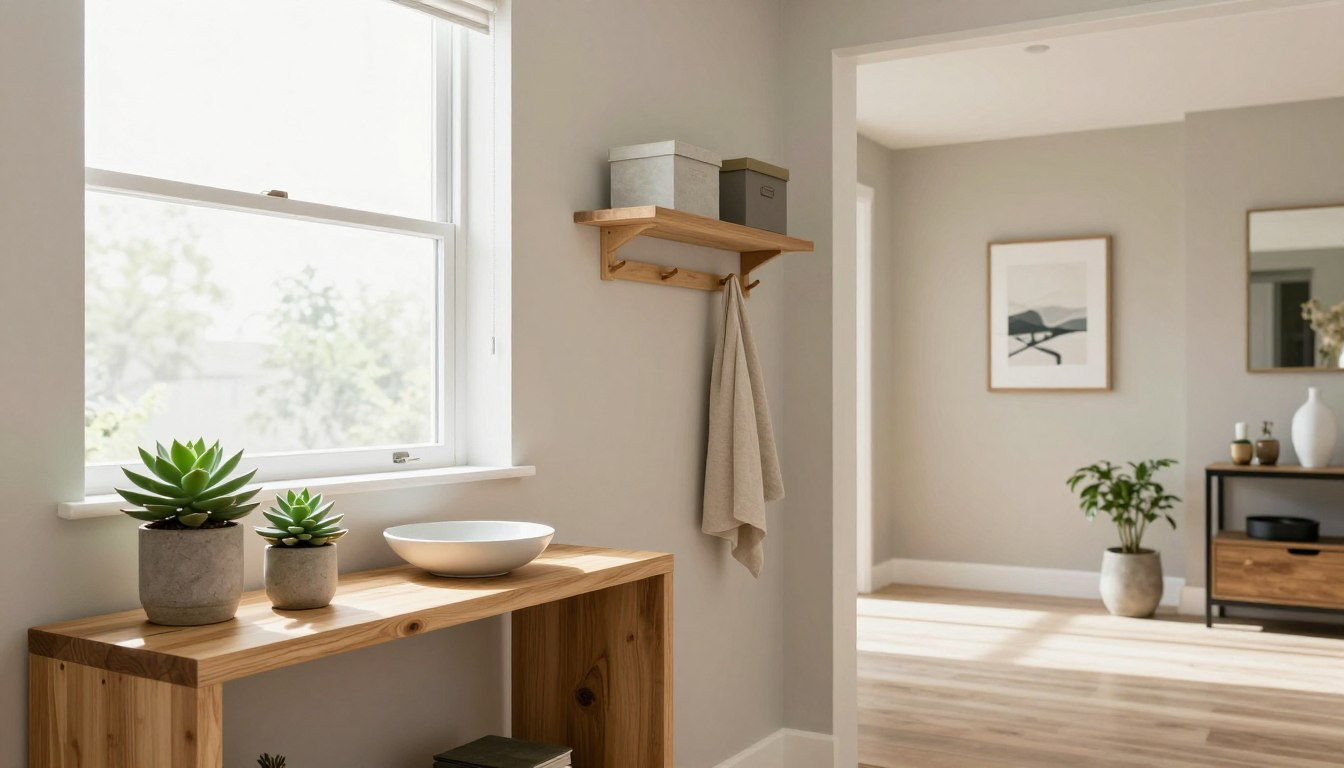
Wall hooks and floating shelves matter more here than in almost any other room, because the floor is often just a walking path a few feet wide. The mistake is hanging hooks at one height — usually shoulder level — and stopping.
Two zones work better: a lower row around waist height for the bag and jacket you grab daily, and a higher shelf for things you touch a few times a season — a spare umbrella, a scarf you wear twice all winter. One crowded row of hooks gets messy within weeks because everything’s competing for the same six inches of wall.
Weight capacity is the renter trap. A Command hook rated for 5 pounds sounds fine until it’s holding a coat, a bag, and an umbrella at once — that’s past the limit, and it eventually peels off with a chunk of paint attached. I know because a hook let go at 7 a.m. and dropped my jacket and gym bag on the floor while I was already running late. If you’re hanging real daily weight, anchor into a stud.
Console Tables Are Often the Wrong Furniture for Narrow Halls
A console table is the default recommendation, and it’s frequently wrong for rental hallways specifically. Under 36 inches of width, a console with a solid base narrows your walking path enough that you’re brushing against it every pass — annoying fast, and it usually ends with you dropping things past the table instead of on it.
In a narrow hall, a slim floating shelf does the same surface job — keys, mail — without eating the walkway. You lose storage capacity though; a floating shelf holds less than a console with drawers. If you actually need hidden storage, go vertical with a tall narrow cabinet instead of fighting for horizontal inches you don’t have.
Shoe Storage Fails Because People Buy for One Person, Not the Household
Shoes are the biggest source of entryway clutter, and most racks are sized for one person’s shoe collection. A slim two-tier rack looks tidy in a product photo, but for two adults with sneakers, boots, and work shoes, it’s full within a month and the overflow lands back on the floor anyway.
An over-the-door organizer on the closet or entry door handles more pairs in the same footprint because it uses vertical door space doing nothing else. But skip the canvas version with deep pockets — I lost a pair of sandals in one for three weeks because I couldn’t see which pocket held what. Clear pockets are less polished-looking and infinitely more useful.
Mirrors Earn Their Space Here — If You Check What’s Behind You First
A mirror in a small entryway does two jobs: practical (last check before you leave) and visual (bouncing light into what’s usually the darkest corner of the apartment, since entryways rarely have windows).
The common mistake is hanging it at a height chosen for wall proportions instead of actual use — I’ve seen mirrors hung so high they only reflect ceiling. Center it so an adult sees their upper body without ducking. And turn around before you hang it: a mirror reflecting a cluttered coat rack or a utility closet door doubles the mess the second you walk in, which defeats the entire point.
Anything over about 15 pounds needs a stud anchor. Adhesive strips will not hold a heavy framed mirror no matter what the packaging claims — I’ve watched one slide six inches down a wall over a summer before I noticed.
Runners Have to Survive Weather, Not Just Photograph Well
An entryway runner takes more abuse than any other textile in the apartment — mud, rain, dropped bags, dragged boots. The mistake is picking based on how it looks rather than how it wears. A flat, low-pile jute or synthetic runner shakes out and vacuums clean; a plush high-pile rug looks great for about three weeks before it’s matted and stained exactly where wet shoes land first, which is the one spot you bought it to protect.
Undersized runners are the other common miss — a runner too short leaves a gap of bare floor right at the wettest point, the exact spot you needed covered.
Removable Wallpaper Behaves Differently Near a Front Door
Entryways are a good place to try removable wallpaper because the wall is usually small and contained. But test a strip first regardless of the brand’s removal claims — the wall near a front door deals with more humidity and temperature swings from the door opening constantly, and that affects adhesive over time. I had a peel-and-stick panel start curling at the edges after four months in an entry, something the identical paper never did in a bedroom in the same apartment.
Hardware Signals Intention, Even When Nobody Consciously Notices
Swapping doorknobs or pulls near the entry is cheap and it works, because it’s the first thing a guest’s hand touches even if they never think about why it feels right. The mistake is mixing finishes by accident — matte black exterior handle, brushed brass interior lever — which reads as unplanned rather than eclectic. Pick one finish and carry it through anything nearby: hooks, light fixture, door hardware. Keep the original hardware in a drawer; most leases let you swap it back at move-out, but confirm with your landlord before you buy anything.
Conclusion: The Habit That Matters More Than Any Decor Choice
The single change that mattered most wasn’t cleaning more — it was giving mail one specific spot instead of letting it land wherever I set my bag down. A tray or wall-mounted slot removes the decision every day. Once keys, mail, and shoes each have exactly one home, the nightly reset takes about ninety seconds, not five minutes, because you’re not deciding where things go, just putting them there.
An entryway doesn’t need to impress anyone. It needs to stop the chaos before it spreads into the rest of the apartment — a much lower bar than most decorating advice makes it sound.
Faqs
Do I really need a bench if I don’t have room for one?
No — a bench is convenient but not essential. If floor space is tight, a low wall-mounted shoe rack solves the “sitting down to put on shoes” problem without taking up any walking room. I skipped the bench in my last apartment entirely and never missed it.
Is it worth buying a hall tree instead of separate pieces?
Only if your entryway is wide enough to fit one without narrowing the walkway. A hall tree looks efficient in photos, but in a hallway under 40 inches wide it usually sticks out too far and becomes something you’re squeezing past daily. Separate wall hooks and a slim shelf are more flexible for tight spaces.
Can I hang heavy coats on adhesive hooks safely?
Not reliably. Adhesive hooks are fine for lightweight items — scarves, a canvas bag — but a winter coat plus anything else on the same hook exceeds most weight ratings quickly. For daily heavy use, a hook anchored into a stud is the safer long-term choice, even though it means a small hole to patch at move-out.
What if my entryway has zero natural light?
This is common in apartment hallways, and the fix isn’t one bright bulb — it’s a warm-toned light paired with a mirror positioned to catch whatever light exists nearby, even light spilling in from an adjacent room. A single overhead fixture alone usually leaves the corners dark no matter how bright the bulb is.
Should the entryway rug match the rest of my apartment’s color scheme?
It should coordinate, but it doesn’t need to match exactly. Since this rug takes the most abuse in the home — dirt, water, dropped bags — durability should drive the choice first, and you can find flat-weave rugs in nearly any color family that hold up well.
How do I decorate an entryway without permanent changes since I’m renting?
Focus on things that install and remove without tools: removable wallpaper (tested first), adhesive hooks for lighter items, a floor mirror instead of a wall-mounted one, and swappable hardware you can reinstall the original pieces for later. Keep the original doorknobs and hardware in a labeled bag so you’re not hunting for them at move-out.
Is a console table necessary, or can I skip it entirely?
You can skip it if your hallway is narrow. A slim floating shelf or a small wall-mounted tray handles keys and mail just as well without narrowing your walking path — the console table isn’t essential, it’s just the most commonly recommended option.