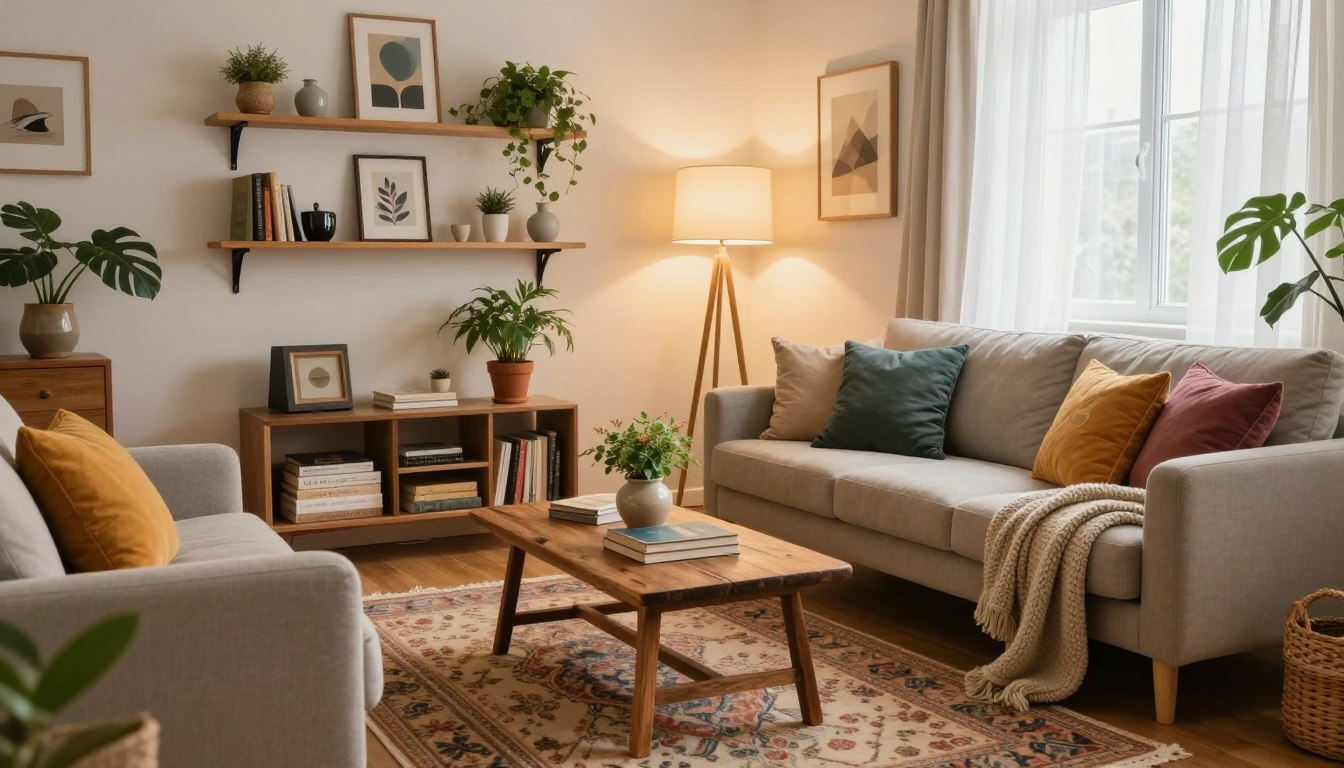
My first apartment living room had a secondhand couch, a lamp from my parents’ basement, and absolutely nothing on the walls because I was terrified of losing my deposit. It looked like a waiting room. What changed things wasn’t a big purchase — it was realizing that coziness comes from about five specific decisions, and almost none of them cost real money. Most of what makes a room feel cold has nothing to do with your budget and everything to do with lighting temperature, textile layering, and furniture arrangement that most people get backwards.
Why Most Small Budgets Get Spent on the Wrong Things
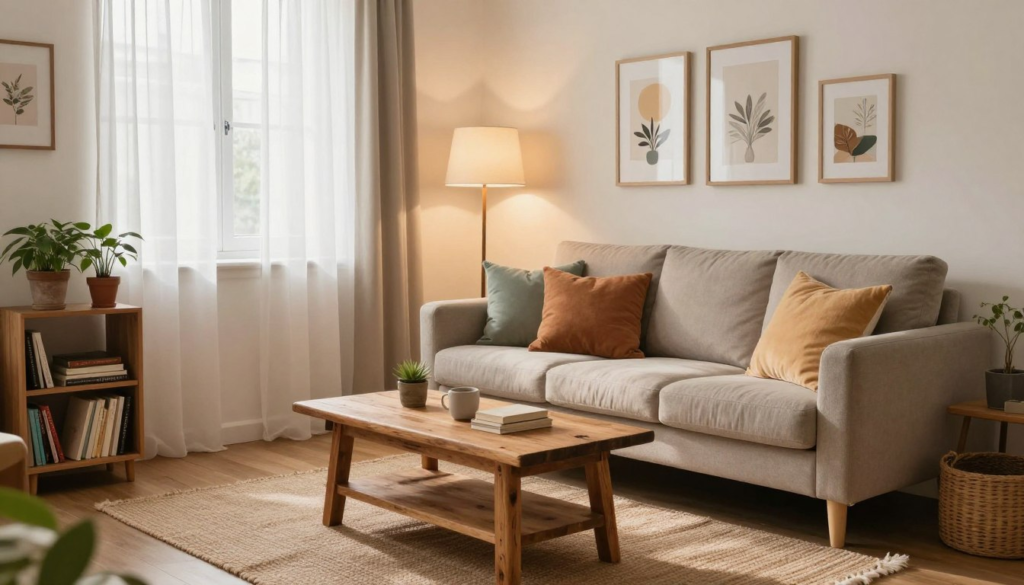
The common mistake is spending the first $200 on decor — a piece of art, some candles, a throw pillow — before addressing the two things that actually determine whether a room feels cozy: light temperature and furniture arrangement. Neither costs anything to fix.
Overhead lighting in most rental apartments comes with a cool-white or daylight bulb by default, because builders buy in bulk and prioritize brightness over ambiance. A bulb rated above 3500K reads as clinical, almost like a dentist’s office, no matter how many blankets you drape around the room. Swapping every bulb in the room to something in the 2700K–3000K range is the single cheapest change you can make, and it does more for “cozy” than any purchase on a typical decor list. I didn’t believe this until I did it in one apartment and the room felt different within the hour, before I’d added a single new object.
Furniture arrangement is the second free fix, and it’s where people get it backwards. The instinct in a small living room is to push every piece against the wall to “save space.” This actually makes a room feel more like a hallway, because it creates one long, empty, unused zone in the middle. Pulling the sofa and chairs even six inches off the wall and angling them slightly toward each other creates a defined seating area instead of a room full of furniture facing a blank wall. In an apartment under 300 square feet this feels counterintuitive, but the trade-off is worth it: you lose a few inches of floor space and gain a room that actually functions for conversation instead of just storage of bodies.
The Lighting Layer Nobody Explains Correctly
Most guides say “add ambient, task, and accent lighting” without explaining why one ceiling fixture alone will never feel cozy regardless of the bulb. A single overhead light source creates flat, even illumination with no shadow or depth — it’s the lighting equivalent of a fluorescent office. Coziness comes from contrast: dim ambient light in the background with pools of warmer, brighter light at specific points, like a reading corner or console table.
The cheapest way to build this is a floor lamp under $30 and one plug-in sconce with an adhesive-mounted cord clip, both on warm bulbs, paired with the overhead light dimmed or turned off entirely most evenings. This is where a lot of renters waste money buying decorative overhead fixtures they can’t even install, when a $12 dimmer plug for an existing lamp achieves the same mood shift instantly and comes off the wall without a trace when you move.
One trade-off worth naming: string lights and LED strips look great in photos but read as dorm-room rather than cozy-adult if they’re the only light source in the room. They work best as a third, subtle layer behind furniture or along a shelf, not as your main lighting plan.
Textiles: Where Cheap Actually Looks Expensive
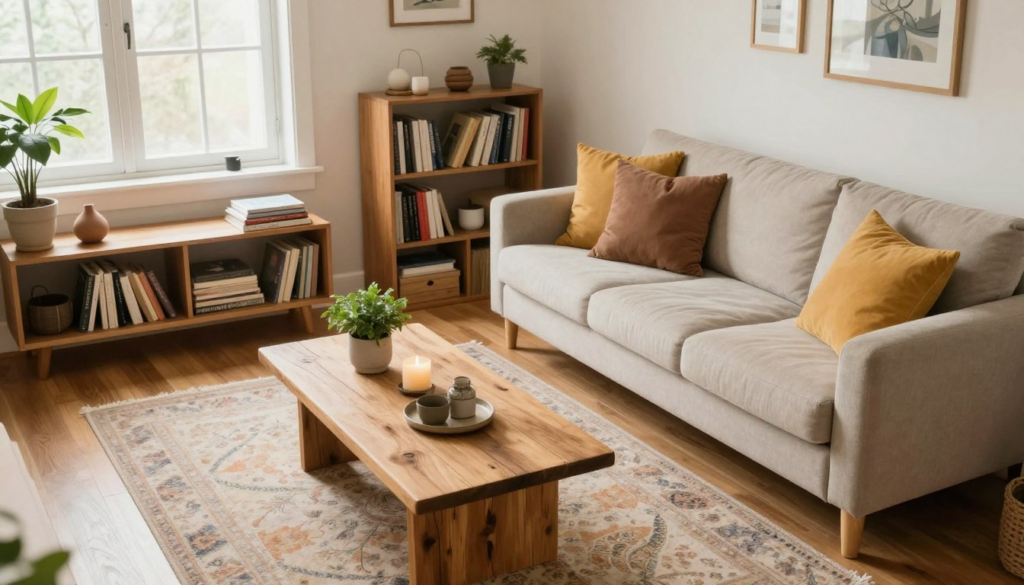
Textiles are the highest return-on-investment category in a budget living room, but only if you understand why texture matters more than color matching. A room with one flat-weave cotton throw and matching pillows looks flatter than a room with three different textures — something knit, something with a slight sheen like velvet, something woven or nubby like linen — even if every item costs the same $15.
The mistake I see most often is buying a matching three-piece pillow set. It looks coordinated in a catalog but flat in a real room because there’s no texture variation for light to catch. Mismatched textures in a consistent color family (say, three shades of warm gray in different fabrics) reads as intentional and layered; perfectly matched pillows read as “I bought a set.”
A rug is the other major lever, and the sizing mistake is almost universal: people buy a rug too small for the room because it’s cheaper, then it floats in the middle like a bath mat. A rug needs to at least reach the front legs of your main seating to visually anchor the space — if your budget only allows for a smaller rug, it’s often better to spend that money on a slightly larger, cheaper jute or synthetic-blend rug than a smaller “nicer” one. Anchoring matters more than fiber quality at this budget tier.
Furniture: Buying Once vs. Buying Cheap Twice
The real cost trap in budget furniture isn’t spending too much — it’s replacing cheap pieces twice. A $150 particleboard coffee table that warps or chips within a year, then gets replaced, ends up costing more than a $250 secondhand solid-wood table that lasts a decade. Before buying new, check Facebook Marketplace or a local estate sale for solid wood pieces — older furniture, even unglamorous 1990s pieces, is frequently built with real wood joinery that outlasts anything at a comparable price point new today.
The multi-functional furniture trend gets recommended constantly, and it’s genuinely useful, but only for specific situations. A storage ottoman works well if you actually need a coffee table and hidden storage in the same footprint — a studio apartment, for instance. It’s the wrong choice in a living room where you already have adequate storage elsewhere, because ottomans as coffee tables are less stable for holding drinks or laptops, and you’re paying a premium for a feature you don’t need.
Walls: The Deposit-Safe Version of a Real Transformation
A gallery wall of thrifted frames looks expensive when the frames are unified by one paint color, even if every frame originally cost $2 and matched nothing. This is the detail most guides skip — buying five mismatched frames and spray-painting them all the same matte black or white transforms them from “thrift store finds” into “curated collection” in about twenty minutes of work. Skipping this step and hanging mismatched frames as-is is the difference between a gallery wall that looks intentional and one that looks unfinished.
For actually hanging things without risking your deposit, the honest trade-off is this: adhesive strips hold reliably on smooth painted drywall for lightweight frames, but they lose their grip in humid rooms or on textured walls, and pulling them off wrong takes paint with the tape. Test one in an inconspicuous spot for a few days before committing an entire gallery wall to them.
Plants and Natural Texture, Realistically
Snake plants and pothos get recommended everywhere because they genuinely tolerate neglect and low light, which matters more than people admit — a $40 fiddle leaf fig that dies in six weeks because your apartment doesn’t get enough south-facing light isn’t a bargain no matter what it cost. Match the plant to your actual light conditions, not the one that looks best in photos.
Conclusion: What Actually Keeps a Budget Room Looking Good Long-Term
The maintenance habit that matters most isn’t cleaning schedules — it’s resisting the urge to keep adding things. A room furnished carefully over three months, with a two-day waiting period before any purchase, ends up more cohesive than one decorated in a single weekend shopping spree, because the pause gives you time to notice what the room actually still needs versus what just looked appealing in a store.
A cozy room isn’t the sum of everything you can fit into it. It’s usually the result of removing one or two things that don’t belong, adjusting the light, and layering texture where there was none — cheaper, and more effective, than most people expect walking in.