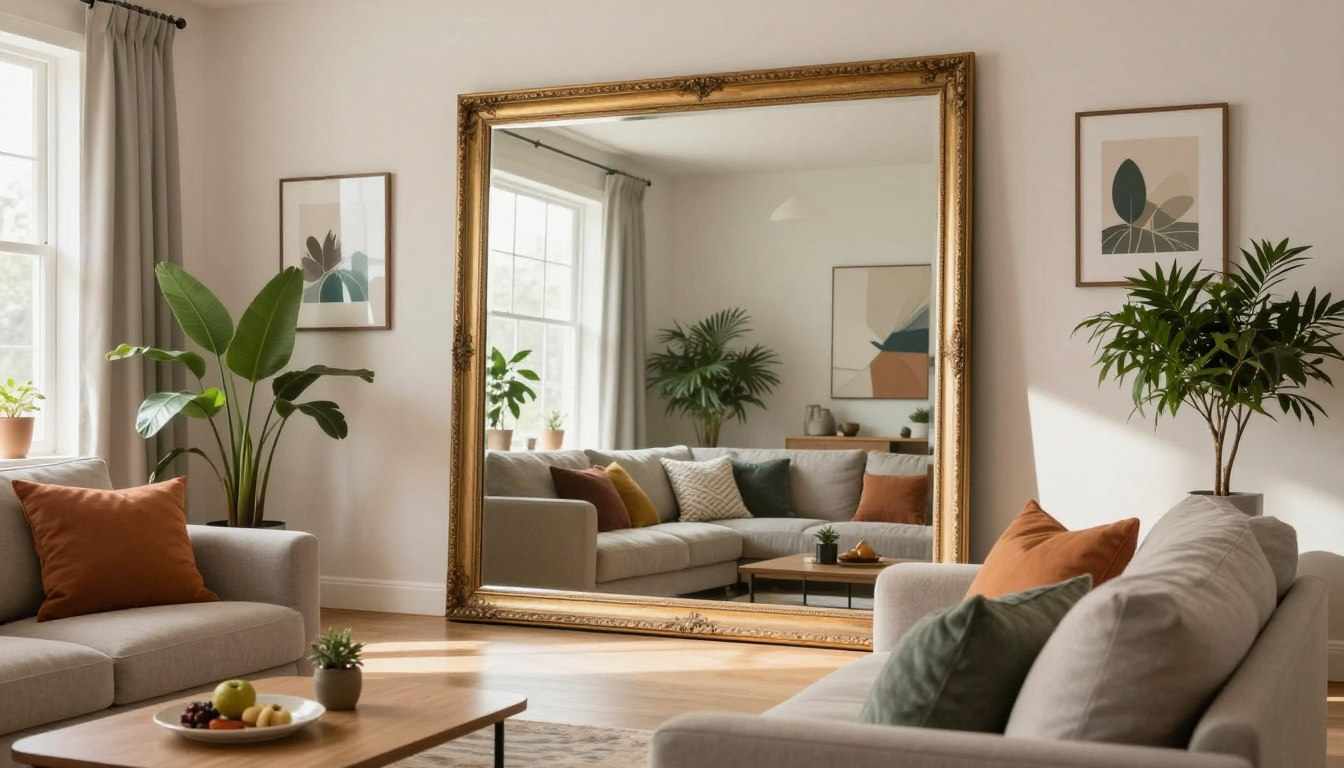
I bought a mirror on sale once because it was 40% off and looked huge in the store. Got it home, held it up above my console table, and it looked like a satellite dish bolted to my living room. The store wasn’t wrong about the mirror — I was wrong to buy it without checking what it had to hang next to.
Scale Is a Relationship, Not a Number
The ratio I actually use every time: a mirror hung above furniture should run two-thirds to three-quarters of that furniture’s width. Narrower and it looks like an afterthought. Wider and it swallows the piece beneath it. I’ve done both — a 24-inch mirror over a 6-foot console looked like a postage stamp, and a mirror slightly wider than my sofa made the sofa look like a bench that had wandered under someone else’s art.
This ratio is a starting point for symmetrical, calm rooms. If you’re going for eclectic or maximalist, an oversized mirror can absolutely work — but own it as a choice, don’t back into it because you didn’t measure first. I can usually tell the difference within about two seconds of walking into someone’s apartment.
Orientation Changes How the Room Reads
A tall, narrow mirror pulls the eye up — good in tight hallways. I have one in a hallway barely 3 feet wide, and anything wider there would have made the space feel like it was closing in on itself. A horizontal mirror stretches the eye sideways, which is why it works above a sofa or a squat dresser far better than a vertical one would.
The actual mistake isn’t ignorance, it’s laziness — people grab whatever orientation happened to be on sale instead of asking what the room is short on. A long, narrow studio living area needs width stretched, not height added. Nobody’s studio apartment has too little ceiling height as its real problem.
Measure for the Things You Can’t Move
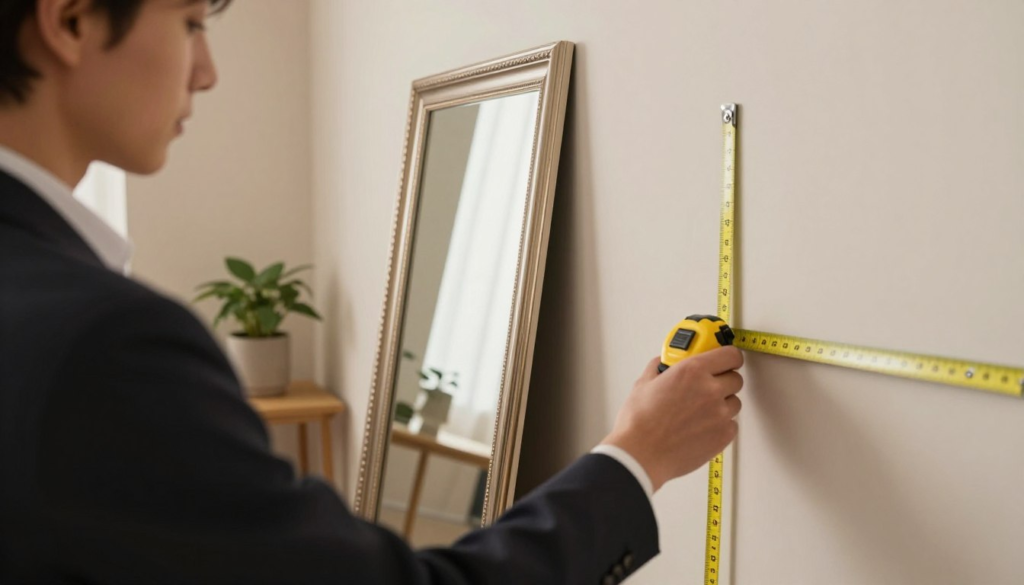
Standard advice says find the wall’s center and measure width. It skips the part where you check for outlets, switches, and thermostats first. I once measured a hallway wall perfectly, ordered the mirror, and got it home before remembering a light switch sat six inches from where the frame’s edge needed to land. The mirror looks fine. The switch plate now looks like it’s been glued on as an afterthought, because it has been.
Tape the mirror’s outline directly on the wall before buying — full size, not a sketch — and leave it up for a day. You’ll catch the problems a tape measure alone won’t: a mirror that blocks a switch, crowds a doorframe, or kills the sightline from your favorite chair.
For sloped ceilings, common in older buildings with converted attic rooms, measure the lowest point of the slope, not the average. A mirror that clears the ceiling at its tallest point but clips the slope on one side will always look tilted, even hung perfectly level.
Decorative and Functional Mirrors Aren’t Solving the Same Problem
A decorative mirror just needs to reflect something worth doubling — a window, a plant, anything but clutter. I once hung a mirror I loved for its frame, only to realize from the couch it reflected my kitchen trash can. No styling trick fixes that; you either move the mirror or live with a framed view of your garbage.
A functional mirror gets sized to your body, not the wall. Vanity mirrors center around 60 inches for an average adult — adjust for whoever actually uses that sink daily, not some hypothetical average person. Full-length mirrors need height more than width; 16–18 inches wide is plenty if the mirror runs floor to well above eye level, which is why the cheap door-mounted ones work fine in a small bedroom.
The Vanity Mirror Ratio People Get Backwards
The common mistake is buying a mirror that matches the vanity’s width exactly. It looks correct on a tape measure and harsh on the wall — there’s zero breathing room, and it fights the backsplash and light fixture instead of sitting among them. Aim for 70–80% of the vanity’s width.
Height matters just as much: bottom edge 5 to 10 inches above the counter. Too low and it pinches against the sink. Too high and it stops looking like it belongs to the vanity at all. If your rental has a pre-installed vanity light, measure its height before ordering — a mirror even an inch too tall will crowd the fixture and make it look like it’s sprouting out of the frame.
Big Mirrors in Small Rooms: The Part Nobody Mentions

The “big mirror makes a small room look bigger” advice is true and incomplete. It only works if the mirror reflects something good — light, a window, a decent view across the room. A big mirror facing a cluttered corner just gives you two cluttered corners. I learned this the annoying way, by hanging a large mirror across from a closet I never got around to organizing, and suddenly having double the mess to look at.
Weight is the renter-specific issue nobody covers honestly. Big mirrors are heavy, and adhesive strips are not the answer no matter what the box promises — you need a stud and a proper anchor, or you skip wall-mounting entirely. I’ve used a leaning floor mirror in two different apartments specifically to dodge this problem; it gets the same light and depth benefit with zero holes.
Conclusion: Gallery Walls Need a Buffer Around the Mirror
If a mirror is going into a gallery wall, give it more breathing room than the frames around it — 6 to 12 inches, not the tighter 2-to-3-inch spacing you’d use between photos. Treat it as the anchor, not just another shape in the grid. Skip this and the mirror just looks like a frame that happened to be reflective.
Getting mirror size right isn’t about finding an impressive number. It’s about actually looking at what your wall, your furniture, and your light are already doing — and not fighting them.
FAQs
Is it okay to hang a mirror that’s bigger than the furniture below it?
It can work, but only if you’re doing it on purpose. An oversized mirror above a small console reads as a bold, intentional choice in an eclectic or maximalist room. The problem is when it happens by accident because you didn’t measure first — that’s when it looks like the mirror and furniture don’t belong together.
What happens if I hang a mirror too high?
The reflection stops being useful and the whole thing starts to feel disconnected from the furniture underneath it. For a decorative mirror over a console or sofa, keep 6 to 12 inches of space between the top of the furniture and the bottom of the mirror — much more than that and it starts floating.
Can a small mirror still make a room feel bigger?
Not really on its own. A cluster of smaller mirrors can add some light and interest, but the “room feels bigger” effect really depends on one larger mirror reflecting something worth doubling, like a window or an open sightline. A small mirror mostly adds detail, not depth.
Should the mirror match my other frames, or can it stand out?
Either works, but pick one on purpose. If you want it blended into a gallery wall, match the frame finish to your other pieces. If you want it to be the focal point, give it more breathing room than everything else around it so it reads as the anchor, not just another frame in the mix.
Is there a wrong place to put a mirror?
Yes — facing anything cluttered. A mirror across from an unmade closet, a trash can, or a messy desk just doubles the mess in the room. Before you hang it, stand where the mirror will be and look at what it’s actually going to reflect.
Do I need a professional to hang a large or heavy mirror?
Not always, but you do need the right anchor. Anything over roughly 15–20 pounds should go into a wall stud rather than relying on drywall anchors or adhesive strips alone. If your rental doesn’t allow wall damage, a leaning floor mirror gets you the same visual benefit with zero holes.
Why does my mirror look off even though I measured everything correctly?
Usually it’s not the measurement — it’s what’s near the mirror that wasn’t accounted for. A light switch, an odd wall texture, or a nearby lamp casting a shadow can all make a technically correct mirror size feel wrong once it’s actually hung.